
UniVirStor 4.19.8 Released: Critical PHP Security Fix (php2shell) and CephFS Snapshot Scheduling | Unified Block, File & S3 Object Storage - Ambedded
UniVirStor 4.19.8 is now generally available. This is an urgent security release: PHP is upgraded to 8.4.27 to fix two critical vulnerabilities (php2shell, CVE-2026-109618 and CVE-2026-109619) that can allow unauthenticated remote code execution, and Ceph is upgraded to 19.2.7 together with the operating system and service packages. Discover Ambedded's Ceph storage appliances and full-stack software. Pre-tuned, web UI, expert support - optimized for AI, cloud, and enterprise workloads.
UniVirStor 4.19.8 Released: Critical PHP Security Fix (php2shell) and CephFS Snapshot Scheduling
UniVirStor 4.19.8 is now generally available. This is an urgent security release: PHP is upgraded to 8.4.27 to fix two critical vulnerabilities (php2shell, CVE-2026-109618 and CVE-2026-109619) that can allow unauthenticated remote code execution, and Ceph is upgraded to 19.2.7 together with the operating system and service packages.
The release also adds CephFS snapshot and schedule management, per-cluster NFS anonymous UID/GID settings, and multiple NTP time sources, and fixes CephFS mounting from older Linux kernels among other issues. Because the vulnerabilities affect all earlier versions, we recommend that all customers upgrade as soon as possible.
Critical PHP Remote Code Execution Vulnerabilities (php2shell) Fixed
On October 21, 2026, the PHP project released urgent security updates for two critical vulnerabilities, known as php2shell. Under certain conditions they allow an unauthenticated attacker to execute code on servers running PHP, and word of the vulnerabilities leaked a day before the official announcement. The UVS Manager web interface runs on PHP 8.4 (nginx with PHP-FPM), so 4.19.8 upgrades PHP to the fixed 8.4.27. This is the primary purpose of the release.
The Two CVEs Fixed in This Release
| CVE | Description | CVSS v4.0 |
|---|---|---|
| CVE-2026-109618 | If a request reaches PHP's memory limit at the wrong moment, PHP can leave partially initialized internal data behind and later treat it as valid, corrupting memory | 9.2 (Critical) |
| CVE-2026-109619 | A fatal error at the wrong point can leave internal state pointing to memory freed by a previous request, which a later request handled by the same PHP worker may then use | 9.2 (Critical) |
Descriptions and CVSS scores are taken from the official PHP announcement. UniVirStor 4.19.7 and all earlier versions ship PHP builds without this fix, so we recommend that all customers upgrade as soon as possible.
What 4.19.8 Covers
| Item | In 4.19.8 |
|---|---|
| PHP 8.4 | Upgraded to 8.4.27, with PHP-FPM and all PHP extensions updated to the same version |
| Legacy PHP leftovers | Nodes upgraded from much older releases may still carry PHP 7.2, which is end-of-life and will never be fixed; the 4.19.8 upgrade removes it completely |
| PHP hardening | The session upload progress feature, which the system does not use, is turned off to further reduce the attack surface; file uploads in the management interface are not affected |
| Go components | Rebuilt with Go 1.27.3 to include the fix for CVE-2026-111943 (Go now rejects a set of intermediate certificates that are no longer trusted during certificate verification) |
Interim Protection Before Upgrading
Until the upgrade is complete, we recommend allowing only trusted management networks to reach the UVS Manager web interface, for example by restricting source addresses with UFW Manager or your existing firewall. This reduces the risk but does not replace the upgrade.
Operating System and Ceph Updated Together
Rather than updating PHP alone, this release takes the opportunity to refresh the entire runtime environment.
Ceph Upgraded to 19.2.7
On October 12, 2026, the Ceph project released Squid 19.2.7, the seventh maintenance release in the Squid series. It fixes CephFS client crashes and deadlocks among other issues, and the Ceph project recommends that all deployments update. Both newly deployed and upgraded UniVirStor 4.19.8 clusters run this version, and offline sites can complete the upgrade with the container images bundled in the upgrade package, without internet access.
Operating System and Service Packages
The operating system kernel, nginx, Samba, time synchronization, and other system packages receive the latest security and maintenance updates.
Shorter Upgrade Time
When an upgrade includes a new operating system kernel, each node must be rebooted in turn. Starting with 4.19.8, the final reboot of the upgrade uses a kexec warm reboot: the new kernel is loaded directly, skipping the BIOS/UEFI power-on self-test and RAID/HBA initialization, which shortens each node's reboot and the time its OSDs are offline. Platforms that cannot use a warm reboot automatically fall back to a normal reboot, and the upgrade continues as usual.
How to Upgrade
Upgrades are carried out with the help of Ambedded support. Nodes are upgraded one at a time, and the services on each node restart briefly in turn. We recommend scheduling the upgrade in a maintenance window.
New: CephFS Snapshot and Schedule Management
The CephFS page adds a Snapshot & Schedule tab, so snapshot management that previously required Ceph commands can now be done directly in UVS Manager.
Manual Snapshots
Select a directory or subvolume in the directory tree to create, view, and delete snapshots, with the creation time of each snapshot shown.
Snapshot Schedules and Retention Rules
Create recurring snapshot schedules for a directory (for example hourly, daily, weekly, or monthly), and edit, delete, or pause them. With retention rules, the system automatically removes snapshots that fall outside the policy, for example keeping the last 24 hourly and 7 daily snapshots.
How Much Space Snapshots Use
CephFS snapshots are copy-on-write: creating a snapshot does not copy the data. The additional space comes from old data that has been modified or deleted after the snapshot was taken but must still be kept by the snapshot, and the raw disk usage is that amount multiplied by the data pool's replica count or erasure-coding overhead. Plan retention rules with your data change rate in mind.
NFS: Anonymous UID/GID Set Per NFS Cluster
Previously, the NFS anonymous UID/GID (Anonymous ID) was a global setting shared by all NFS clusters. In 4.19.8 it is set per NFS cluster: you can specify it when creating an NFS cluster and view or change it later when editing the cluster, and the values shown are the ones actually in effect in Ceph. A change applies only to that cluster and does not affect the others.
This lets you separate clients with different trust levels, for example mapping a cluster that serves internal workstations to domain users while mapping a cluster for external or lab hosts to an unprivileged account. It also fixes an issue in earlier versions where changing or clearing the Anonymous ID of a cluster that already had one reported success but left the actual setting unchanged. After upgrading from an earlier version, each cluster keeps the settings actually in effect in Ceph; check the anonymous UID/GID on each cluster's edit screen to confirm they are as expected.
NFSv3 Fixes
When several NFS clusters enable NFSv3, each now uses its own configuration without affecting the others, and adding a host to an NFS service with NFSv3 enabled no longer breaks its NFSv3 settings.
System Time: Multiple NTP Sources
UVS Manager previously supported a single NTP server. 4.19.8 supports multiple external NTP servers and lets you choose whether the Ceph MON nodes provide internal time synchronization for the cluster; internal and external sources can be used together. Multiple independent time sources let the system cross-check them and exclude a faulty clock, which matters especially for a distributed system such as Ceph that depends on consistent time across nodes. The time zone setting is now a searchable list as well.
Monitoring, Reports, and Notifications
SMB and NFS Service Status on the Dashboard
Storage Service Status on the Dashboard now includes SMB and NFS, showing the number and status of these services at a glance.
More Accurate Memory Usage
Dashboard memory usage is now calculated from the available memory reported by the Linux kernel, so reclaimable file cache is no longer counted as used. This avoids persistently high readings that could be mistaken for a memory shortage.
Report Time Range and Time Zone
Cluster Report calculates full days in the cluster's time zone (00:00 on the start date to 24:00 on the end date) and clearly shows the start time, end time, and time zone, and the dates of manual reports now match those of scheduled report emails. Scheduled report emails also include a PDF version of the report, and wide tables in the PDF are now shown in full instead of being cut off.
SMTP Servers Without Authentication
The SMTP username and password in the notification settings are now optional, so an internal mail relay that does not require authentication can be used. At least one recipient is now required.
Fixes
CephFS Mounting From Older Linux Kernels
In 4.19.7, CephX users created from the interface always received aes256k keys, so kernel clients older than Linux 7.0 could not mount with the command generated by HOW TO MOUNT. In 4.19.8, HOW TO MOUNT lets you choose AES-128 or AES-256 when creating the default user: AES-128 works with Linux kernels older than 7.0, and AES-256 is for clients that support the new key type, so there is no longer any need to create a compatible user with commands. In addition, the CephX Auth page now shows the error returned by Ceph when creating, editing, or deleting a user fails, instead of reporting success.
SMB
Closing sessions and open files on the SMB STATUS page now takes effect, works for connections held by other nodes, and shows an error if the operation fails. Adding an SMB share no longer overwrites the permissions of the subvolume group root directory, permission handling is now the same for adding and editing shares, and a domain user and group can be selected as the owner when editing a share. After an LVS VIP is set, the SMB cluster service no longer restarts repeatedly and drops connections, and deleting the LVS VIP now removes the address from every node.
UFW Manager Firewall
Rule import now accepts rules whose source or destination is a network (CIDR), so files exported by UVS can be imported back unchanged, and a failed import now shows an error instead of reporting success. A rule whose destination is a network also no longer loses that network when edited or exported, which previously widened it to any address.
S3 Object Storage (RGW)
When adding a zone placement and switching the Bucket Index Pool option from “Use existing pool” back to “Create”, a new index pool is now created correctly with the selected CRUSH rule. A new Reset Endpoint action resynchronizes the zone and zonegroup endpoints from UVS Manager after RGW services have been changed elsewhere, such as in the Ceph Dashboard.
System Logs
Management interface logs are now compressed daily, preventing the log directory from growing without limit and filling the system disk.
Frequently Asked Questions
▾What are the main updates in UniVirStor 4.19.8?
This is an urgent security release: PHP is upgraded to 8.4.27 to fix two critical vulnerabilities (php2shell) that can allow unauthenticated remote code execution, and Ceph is upgraded to 19.2.7 together with the operating system and service packages. The release also adds CephFS snapshot and schedule management, per-cluster NFS anonymous UID/GID settings, and multiple NTP time sources, and fixes a number of issues.
▾Is my system affected by php2shell?
UniVirStor 4.19.7 and all earlier versions ship PHP builds without this fix, so we recommend that all customers upgrade to 4.19.8 as soon as possible. Until then, allow only trusted management networks to reach the UVS Manager web interface to reduce the risk.
▾Will services be interrupted during the upgrade?
Nodes are upgraded one at a time, and the services on each node restart briefly in turn. 4.19.8 uses a kexec warm reboot to shorten each node's reboot. We recommend upgrading in a maintenance window with the help of Ambedded support.
▾Can Linux kernels older than 7.0 now mount CephFS?
Yes. Choose AES-128 when creating the default user in HOW TO MOUNT, and the generated command works on Linux kernels older than 7.0. Clients using AES-256 keys need Linux kernel 7.0 or later, or ceph-fuse 19.2.6 or later.
▾How much space do CephFS snapshots use?
Creating a snapshot does not copy any data. Additional space comes from old data that was modified or deleted after the snapshot but is still kept by it, multiplied by the data pool's replica count or erasure-coding overhead. The more snapshots you keep and the more often data changes, the more space they use, so set retention rules accordingly.
Upgrade and Support
That covers the updates in UniVirStor 4.19.8. Because this release fixes critical remote code execution vulnerabilities, we strongly recommend that all customers schedule an upgrade as soon as possible.
Existing customers can contact Ambedded support to receive the update package and upgrade guidance. To discuss an upgrade plan or learn more about any capability in this release, please get in touch, email service@ambedded.com.tw, or visit the UniVirStor enterprise Ceph software-defined storage product page.
About Ambedded Technology
Founded in 2013, Ambedded Technology is a technology provider specializing in Ceph software-defined storage. Combining deep knowledge of open source software, Ceph distributed storage, embedded Linux, and Arm-based architecture, Ambedded delivers Ceph storage solutions ranging from software-only to turnkey appliances, together with Ceph consulting, professional services, and seamless updates — helping enterprises, government agencies, and academic institutions build scalable, highly reliable storage infrastructure at a lower total cost of ownership.
- Related Products
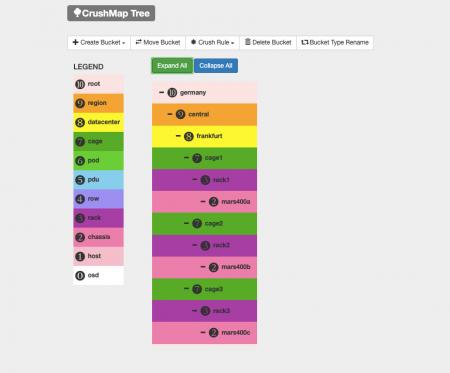
Ceph Management Web User Interface (UVS Manager)
Unified Virtual Storage (UVS) is a software package that integrates Linux operating system, Ceph distributed storage software, management console, and the web-based...
Details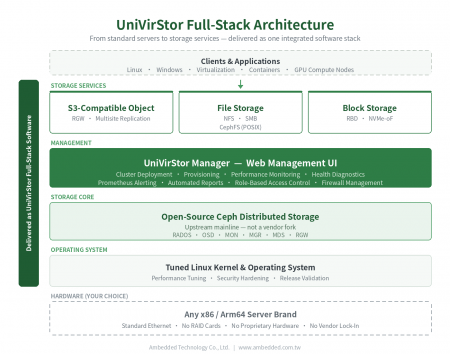
UniVirStor Enterprise Ceph Software-Defined Storage
UniVirStor is Ambedded's full-stack enterprise Ceph software-defined storage. It integrates a tuned Linux kernel and operating system, Ceph storage software,...
Details
Hot Products
 Download
UniVirStor 4.19.8 Released: Critical PHP Security Fix (php2shell) and CephFS Snapshot Scheduling | Ceph Storage Solutions; Ceph Appliances & Software|Ambedded
Founded in Taiwan in 2013, Ambedded Technology Co., Ltd. is a leading provider of block, file, and object storage solutions based on Ceph software-defined storage. We specialize in delivering high-efficiency, scalable storage systems for data centers, enterprises, and research institutions. Our offerings include Ceph-based storage appliances, server integration, storage optimization, and cost-effective Ceph deployment with simplified management.
Ambedded provides turnkey Ceph storage appliances and full-stack Ceph software solutions tailored for B2B organizations. Our Ceph storage platform supports unified block, file (NFS, SMB, CephFS), and S3-compatible object storage, reducing total cost of ownership (TCO) while improving reliability and scalability. With integrated Ceph tuning, intuitive web UI, and automation tools, we help customers achieve high-performance storage for AI, HPC, and cloud workloads.
With over 20 years of experience in enterprise IT and more than a decade in Ceph storage deployment, Ambedded has delivered 200+ successful projects globally. We offer expert consulting, cluster design, deployment support, and ongoing maintenance. Our commitment to professional Ceph support and seamless integration ensures that customers get the most from their Ceph-based storage infrastructure — at scale, with speed, and within budget.